
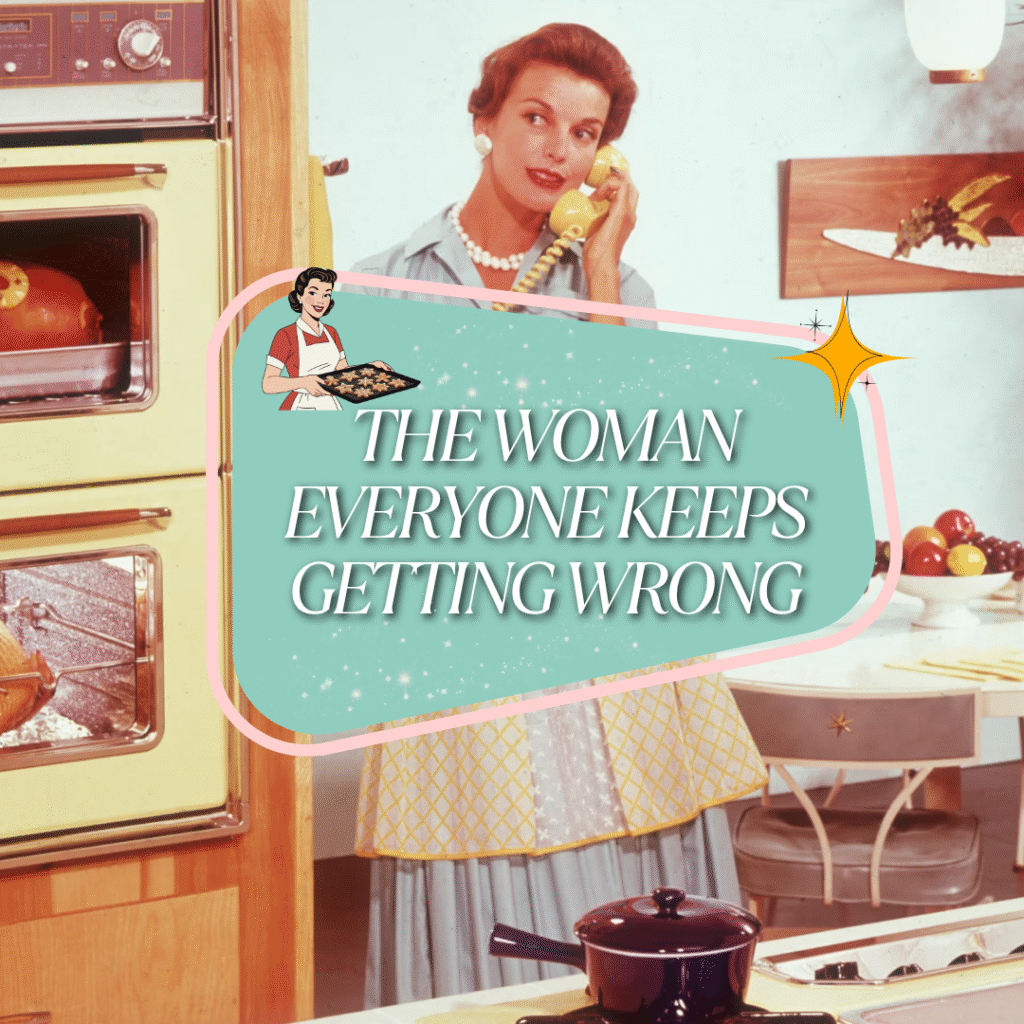
It’s become “trendy” to mock her- the woman in pearls, lipstick, & an apron. She’s shoved into a pre-cut, stereotypical box: a smiling servant, silenced by society, trapped in a kitchen she never chose. But here’s the thing, my friends: that wasn’t the whole story.
Yes, the 1950s came with limits and unfairness, 100%. Women did face real discrimination in the workplace, in law, and in social expectations. Some were genuinely miserable, others quietly oppressed. BUT to claim all women were victims is like trying to erase the literal millions who on the other hand, lived full, vibrant, purposeful lives. Amazing women who built families, ran homes like empires, and shaped communities through intelligence, grace, and grit. We always hear about the “beaten down & trodden housewife” of the era. To be honest, that is all I ever hear people repeat online today. The funny thing to me was, the people telling me this weren’t even actually people who lived in that time or era and it often completely contradicted what actual women I knew personally had told me who were wives and mothers during that time, or the daughters of women during that time…including my very own Grandmother. It was so strange to me. There was, and more than ever now, seems to be a narrative that wants to convince people that these women, every single one, were miserable and trapped in a loveless, abusive marriage. Plenty of research paired with listening to and reading actual real stories about people’s family members quickly proved that this topic isn’t as black and white as today’s world would have one believe. There was much more nuance to it.
They Were Homemakers, Not Helpless
The typical 1950s housewife wasn’t simply folding laundry and waiting anxiously for her husband’s return to greet him with a kiss, slippers, and pipe like the 1950s sitcoms would have you believe. She was busy! She was often managing the household finances, planning meals from scratch, volunteering in her community, raising well-mannered children, & keeping family life running like clockwork. She balanced countless responsibilities, all without today’s Google calendars, any stupid AI nonsense, meal prep kits, or Uber Eats.
She wasn’t “just” a homemaker. She was the heartbeat of the home – part CEO, part nurse, part chef, part counselor. And while her work often went unpaid, it was never unimportant. It angers me when I hear people discount a woman’s role if she says she is a stay-at-home-mom and or wife. It’s as if they don’t view it as an actual job when it is as every much as a job as someone who drives to work and clocks in and out of it.
Yes, Many Women actually Worked- AND Loved It
Despite what today’s social media would have you believe, women in the 1950s did work – millions of them, married with families or not. Some were teachers, nurses, writers, secretaries, shop owners, bank tellers, and factory workers. Some families simply could not afford the luxury of a one income household. Even my own Grandmother worked while being married and having two daughters. Many women were even encouraged by their husbands to work. Dual-income families weren’t as rare as modern narratives suggest. In 1956, LIFE Magazine did a special feature on the twenty-seven-year-old Jennie of Hammond, Indiana– a working wife & mother.
” worked in the bridal service at a local department store, and her husband Jim as a junior executive at a steel company. Her job afforded her a social life with coworkers. It brought the family more disposable income. It provided time for her and Jim, on their drive home together, to talk without the distractions of a hectic household. And both parents” time away from home meant that when they were with their children, they were entirely focused on enjoying time as a family.” Source: LIFE
Women joined the military, went to college, managed church fundraisers, and handled community affairs. They read, they learned, they led, often in spaces the world underestimated.
Partnership, Not Prison
“Perhaps the most telling aside in the essay is that Magill, who by all appearances had what we might today call “it all,” could not do what she did alone. Not only was she “blessed with a loyal, experienced housekeeper,” but Jim “enthusiastically approves of the idea” of her working outside the home. And while both partners worked outside the home, they also both worked inside of it. “We all live here,” said Jim, “so why shouldn’t we all help out?” Source: LIFE
Contrary to the “patriarchy-only” myth, plenty of 1950s marriages were genuine partnerships. Husbands respected their wives’ roles, worked tirelessly to provide stability, and often relied on their wives’ insight and wisdom behind the scenes. Many women influenced their husbands’ careers, communities, and even politics quietly from home – not because they were powerless, but because they understood that influence doesn’t always need to shout. Their power was subtle but steady. Emotional intelligence long before it was a “buzzword”.
These marriages were built on mutual respect and shared purpose. They were about teamwork: a husband striving to create a better life for his family, and a wife guiding, advising, and supporting him while managing her own sphere of influence. Love, trust, and partnership weren’t absent; they were often the very foundation of a family’s success. While not every marriage fit this ideal, many were far from loveless or abusive, they were instead collaborative, aspirational, and deeply committed to one another’s growth and happiness.
Femininity Wasn’t Weakness, It Was Strength
We often confuse gentleness with fragility. But the women of that era embodied a rare kind of strength: disciplined, polished, and enduring. They faced societal pressure and personal challenges without the luxury of oversharing or outsourcing. They did hard things gracefully, and that deserves respect, not ridicule.
Women certainly could stand up for themselves, their families, or a cause when need be. My grandmother was the most graceful, calm, and even-keeled woman.. but mess with her or her family, and she knew how to “deal with it” tactfully yet sharply. Let me be clear: You did NOT mess with her. 
Femininity was their language of power. They knew how to command a room with presence, not volume.
Acknowledging Both Truths
It’s important to be clear: no one’s pretending the 1950s were perfect. Many women were indeed mistreated or limited, just as they are today in the 21st century and we must never, ever romanticize that pain. Just as I have heard plenty of lovely stories about the good lives women led back then, I have also heard the latter.
BUT the scales weren’t as one-sided as we’ve been told, and this is what drive me a little nutty. Highlighting the positive doesn’t erase the negative – it balances it. It allows us to tell the truth fully, instead of flattening history into black-and-white extremes.
Our women ancestors deserve to have ALL of the story told, don’t you think??
Why Does This Matter Now?
The modern woman is told she can “have it all,” yet she’s often burned out, lonely, and overstimulated. Maybe, just maybe, the women of the 1950s understood something we’ve forgotten – about pace, about presence, about the power of choosing what fulfills you rather than what “impresses” others.
You can be a housewife AND powerful. You can be a career woman AND nurturing. You can embrace the traditional without rejecting the modern.
The goal isn’t to go back in time, it’s to remember what “progress” has tried to erase: That womanhood has always had range.